

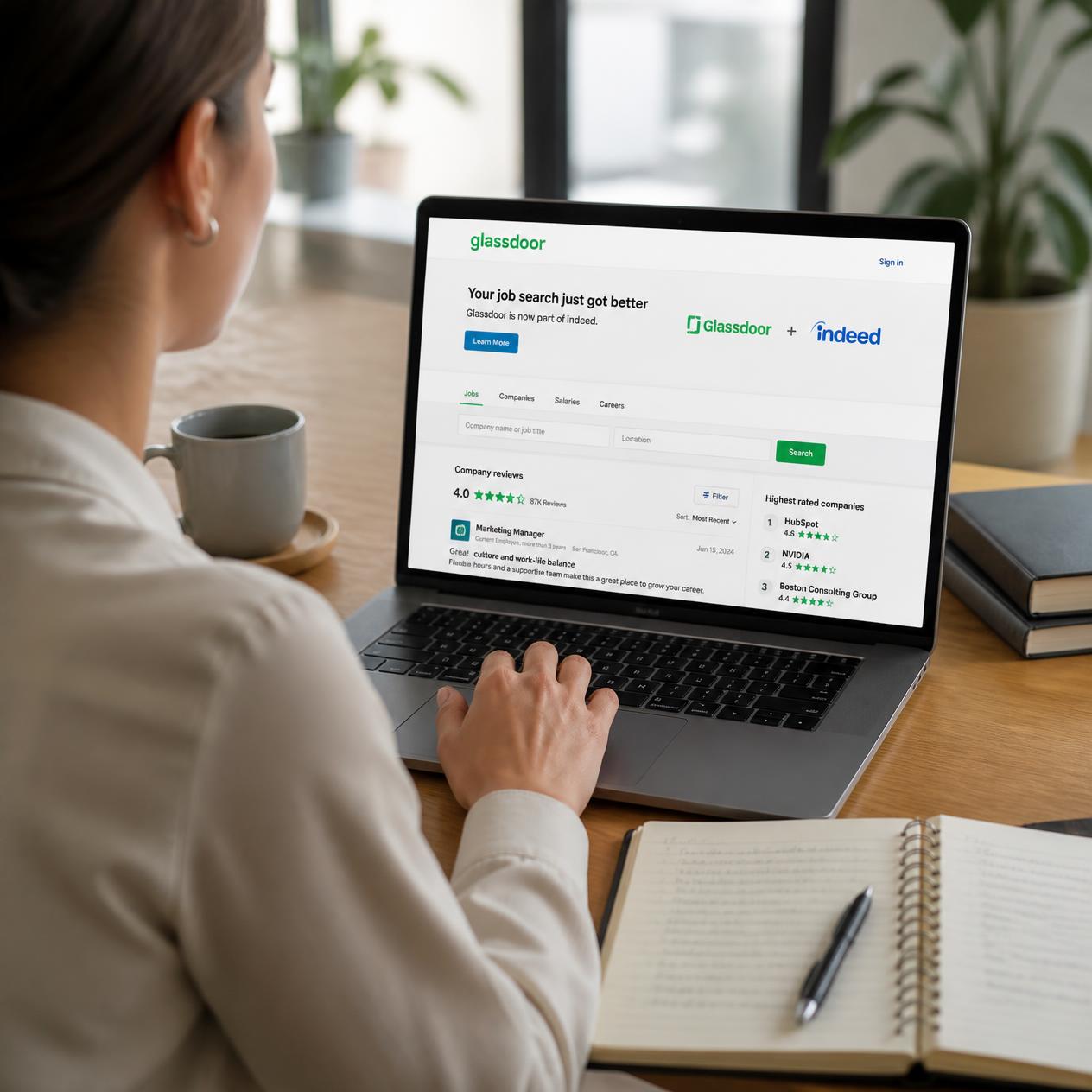

The Glassdoor Indeed merger completed on 1 July 2026. Your accounts have been linked, your terms of use have changed, and the second opinion you thought you were getting when you checked a company on both sites has quietly become a first opinion.
What the Glassdoor Indeed merger actually changed
On 1 July 2026, Glassdoor legally merged into Indeed as a single operating entity. Strictly speaking this is not a surprise. Both sites have been owned by the same parent, the Japanese group Recruit Holdings, for years: Indeed since 2012, Glassdoor since 2018. Operational integration started in 2020. The July date closed it.
It followed a hard eighteen months. Recruit Holdings cut around 1,300 roles from its HR technology division in July 2025, roughly six per cent of that segment, with a smaller round in November. Glassdoor’s chief executive, Christian Sutherland-Wong, left the business that same month. The company has framed the whole consolidation around AI and efficiency.
Glassdoor has not disappeared. glassdoor.co.uk is still live, still carrying UK reviews and salary data, and still running its Best Places to Work UK list. What changed is the plumbing behind it.
The short version
- Glassdoor and Indeed are one legal entity as of 1 July 2026, under Recruit Holdings.
- Both brands and both websites still operate.
- Existing Glassdoor users had to link to an Indeed login by 20 April 2026.
- You now sit under Indeed’s terms of use and privacy policy.
- Reviews remain anonymous, with an important caveat below.
What is different for you as a job seeker
Your two accounts are now one account
Existing Glassdoor users were required to connect to an Indeed login by 20 April 2026 or lose access. Once the accounts are linked, you cannot unlink them without deleting one of them entirely. Profile information now syncs across both platforms.
One set of terms, one privacy policy
You are now covered by Indeed’s terms and privacy policy. If you signed up to Glassdoor in 2019 on the basis of what it promised then, that is no longer the agreement you are under. It is worth five minutes to read what you have actually agreed to, particularly if you have used the same email address for job applications and for leaving reviews.
The job listings are the same listings
Postings sync automatically between the two sites, so searching both is duplicated effort. Use Indeed to find roles and Glassdoor to research them. Treating them as two separate searches will not surface anything new.
The cross-check has gone
This is the change that matters most, and almost nobody is talking about it. Checking a company on Glassdoor and then on Indeed used to feel like getting a second opinion. It is now one opinion, from one company, under one moderation policy, with one commercial relationship with the employer you are researching.
The anonymity question, answered honestly
Reviews are still anonymous. Glassdoor has been consistent that it does not publish names alongside review content, and that has not changed with the merger.
The reason people stopped trusting that promise is a separate episode. In March 2024, users discovered their real names had been added to their Glassdoor profiles without being asked. In one widely reported case, the name had been taken from the “from” line of an email the user had sent to customer support. The change traced back to Glassdoor’s 2021 acquisition of Fishbowl, which required verified identities, and a corresponding update to the terms of service.
Glassdoor’s position was that a profile name and a review are two different things. Technically that is correct. It also explains why a lot of people deleted their accounts.
The practical point for you: Glassdoor’s own policy does not guarantee anonymity if a review contains details that identify the writer. If you are thinking of reviewing a team of six, assume your manager could work out who wrote it. Write about patterns, not incidents.
Glassdoor alternatives worth using for UK company research
No single site replaces Glassdoor. The answer is to use two or three, chosen for what you are actually trying to verify. These are the ones I point UK clients towards.
| Site | Best for | Watch out for |
|---|---|---|
| Glassdoor UK | Still the deepest pool of UK employee reviews and salary data | No longer an independent check on Indeed |
| TheJobCrowd | UK graduate schemes and apprenticeships, ranked on anonymous feedback from graduate employees | Reviews carry no visible dates; little use above early career |
| Higherin | Placements, internships and apprenticeships. This is RateMyPlacement and RateMyApprenticeship, rebranded in August 2025 | Early career only |
| Welcome to the Jungle UK | UK startups and scale-ups, with company profiles covering pay, diversity and working style. This is where Otta went | Profiles are editorial and company-supplied, not anonymous reviews |
| Built In | Tech employers, with genuine coverage of London, Edinburgh, Glasgow and Belfast | Employer-written profiles; tech and startups only |
| Levels.fyi | Salary benchmarking in sterling, by company and level, before you negotiate | Tech roles only, and pay data tells you nothing about culture |
| Blind | Candid talk about layoffs, management and pay in tech, finance and large corporates | Heavily US-weighted, thin on UK employers, and often unpleasant |
| Companies House | Filed accounts, director changes and group structure. Free, factual and impossible to game | Tells you about the finances, not the manager |
A few well-known names are worth a caveat. Comparably gives good culture and leadership breakdowns but its coverage is thin outside the United States. Fairygodboss and InHerSight are the best-known places to research parental leave, flexibility and how women actually experience an employer, and both are worth your time if you are looking at a US company. Neither has meaningful UK employer coverage, and Fairygodboss and The Muse both changed hands quietly in 2025 with significant staff losses, so I would not build a research habit around either persisting. Great Place To Work UK publishes UK rankings, but remember employers pay to be surveyed.
The most valuable source is not a website. It is one person who has recently left.
How to read a review page without being misled
- Ignore the average. A 3.8 made of a hundred fours tells you something completely different from a 3.8 made of fives and ones. Look at the distribution, not the headline.
- Read the newest negative reviews first. Older complaints may have been fixed. Recent ones are your best guide to what you would actually walk into.
- Look for repetition, not intensity. One furious review about a named manager is a bad relationship. The same complaint about workload or promotion appearing across four years is a structural problem.
- Match the reviewer to your role. A five-star review from a graduate in a different office and a different function tells you very little about a senior appointment in the division you would be joining.
- Watch the timing. A cluster of positive reviews appearing in a single month usually means an internal push. A cluster of negative ones usually follows a restructure. Both are signals.
- Cross-check against hard evidence. Filed accounts at Companies House, the annual report, regulator findings, redundancy coverage in the trade press and what current employees post publicly on LinkedIn.
- Ask a human one neutral question. “What would you want to know before joining?” works far better than “is it a good place to work?” Ten minutes of that beats an hour of star ratings.
- Require three sources. If a concern appears in only one place, treat it as a question to ask at interview rather than a fact.
One more habit worth building. Do your research logged out where you can, and be deliberate about which accounts you connect to each other. Now that a Glassdoor profile and an Indeed profile are the same profile, the research you do and the applications you make sit in the same place.
Common questions about the Glassdoor Indeed merger
Is Glassdoor shutting down?
No. Glassdoor and glassdoor.co.uk are still live and still publishing reviews and salary data. The merger changed the legal and account structure behind the site, not the site itself.
Are Glassdoor reviews still anonymous?
Reviews are not published with your name attached, and that has not changed. Glassdoor’s own policy stops short of guaranteeing anonymity if a review contains details that identify the writer, so be careful about specifics if your team is small.
Do I have to link my Glassdoor account to Indeed?
Yes, if you want to keep using it. Existing users had to link by 20 April 2026. Once linked, the accounts cannot be separated again without deleting one of them.
What is the best Glassdoor alternative in the UK?
There is no single replacement. For graduate and apprentice roles, use TheJobCrowd and Higherin. For startups and scale-ups, Welcome to the Jungle UK. For tech pay, Levels.fyi. For financial health, Companies House. Combine two or three rather than swapping one site for another.
What I would do this week
Check what your linked Glassdoor and Indeed profile currently shows about you, including your name, and adjust it if you are not comfortable with it. Pick a second research source from the table above that fits your sector and bookmark it. Then, for the next employer you are seriously considering, find one person who has left in the last two years and ask them that one question.
Company research is not a rating. It is a shortlist of questions you take into the interview room.
Sources
- Glassdoor’s long merger with Indeed is finally done, Reworked
- Glassdoor is now officially part of Indeed, The People’s Board
- Indeed vs Glassdoor 2026: merger impact on privacy and job search, Vocational Guide
- Users say Glassdoor added real names to user profiles without their consent, TechCrunch
- Addition of Glassdoor user’s name to profile raises privacy concerns, SHRM
- RateMyPlacement and RateMyApprenticeship have rebranded to Higherin
- UK recruitment platform Otta acquired by Welcome to the Jungle
- The Muse acquired, Job Board Doctor
